The experimental theater group Elevator Repair Service has made its name in marathon adaptations of major modernist novels. The most famous, Gatz, runs over eight hours and includes a recitation of Fitzgerald’s entire book. ERS has also tackled The Sound and the Fury (2 hours 40 minutes) and The Sun Also Rises (3 hours 15 minutes). It seems inevitable, then, that the group would find its way to Joyce, and considering the long history of reading excerpts from the novel on Bloomsday, it makes sense that they would select Ulysses. Despite its length and its reputation for obscurity, Joyce’s prose is musical and well-suited to the theater, and some of the book’s most famous sequences include one written as a script (Circe) and another that is in essence a monologue (Penelope). The Zurich James Joyce Foundation lists fifteen previous stage adaptations of Ulysses.
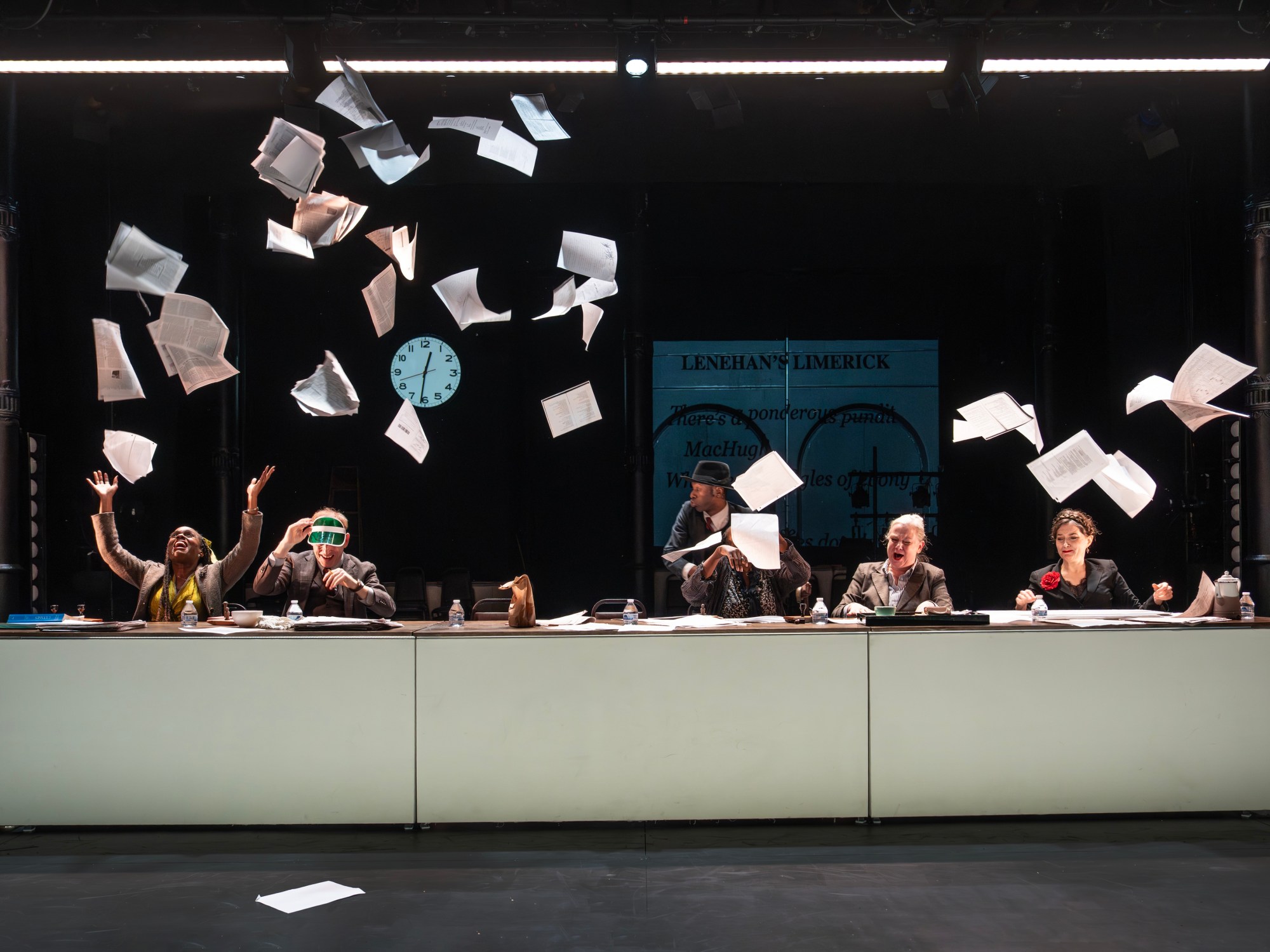
Like Gatz, the production begins with minimal fanfare. Scott Shepherd introduces the project (“Get ready”) and then the other actors, in modest, conservative clothing, take their places at a long table facing the audience. Then, they read the book—or rather, large chunks of the book. Elisions are marked by the sound of a tape fast-forwarding, the missing text speed-projected under the table, like a teleprompter that’s gone rogue. A clock in the background helps the audience keep track of time. As it passes, the actors assume more theatrical costumes, often leaving their chairs to act out in addition to reading the text. ERS has made sure to include pieces from every chapter, and anyone familiar with the material will recognize the “greatest hits.” It culminates, of course, in one of the most beautiful and humanizing passages ever written.
Unlike Gatz, this Ulysses limits itself to the source material. The earlier production had a kind of alternate narrative going on alongside Fitzgerald’s. It begins with an office worker picking up the novel, and so the story is not only about Nick and Daisy and Gatsby but the reader, too. There is no second story to serve as a foil to the first. The result is that this Ulysses can often feel like a well-financed, well-cast Bloomsday reading. Moreover, because of the necessary cuts, I wonder how well audience members unfamiliar with the novel will fare. Then again, perhaps they will fare just as well as a first-time reader, who must soon become comfortable with the fact that they will not understand it all, will never understand it all.
While I found myself disappointed with this production, I do hope ERS will continue their work. Though Ulysses is more well-read, Finnegans Wake is even more lyrical, more playful, and more suited to be spoken aloud. Or perhaps Virginia Woolf?
Ulysses runs through March 1st at Martinson Hall. 425 Lafayette Street New York, NY. 2 hours 45 minutes. One intermission. Photograph by Joan Marcus.
 scribicide