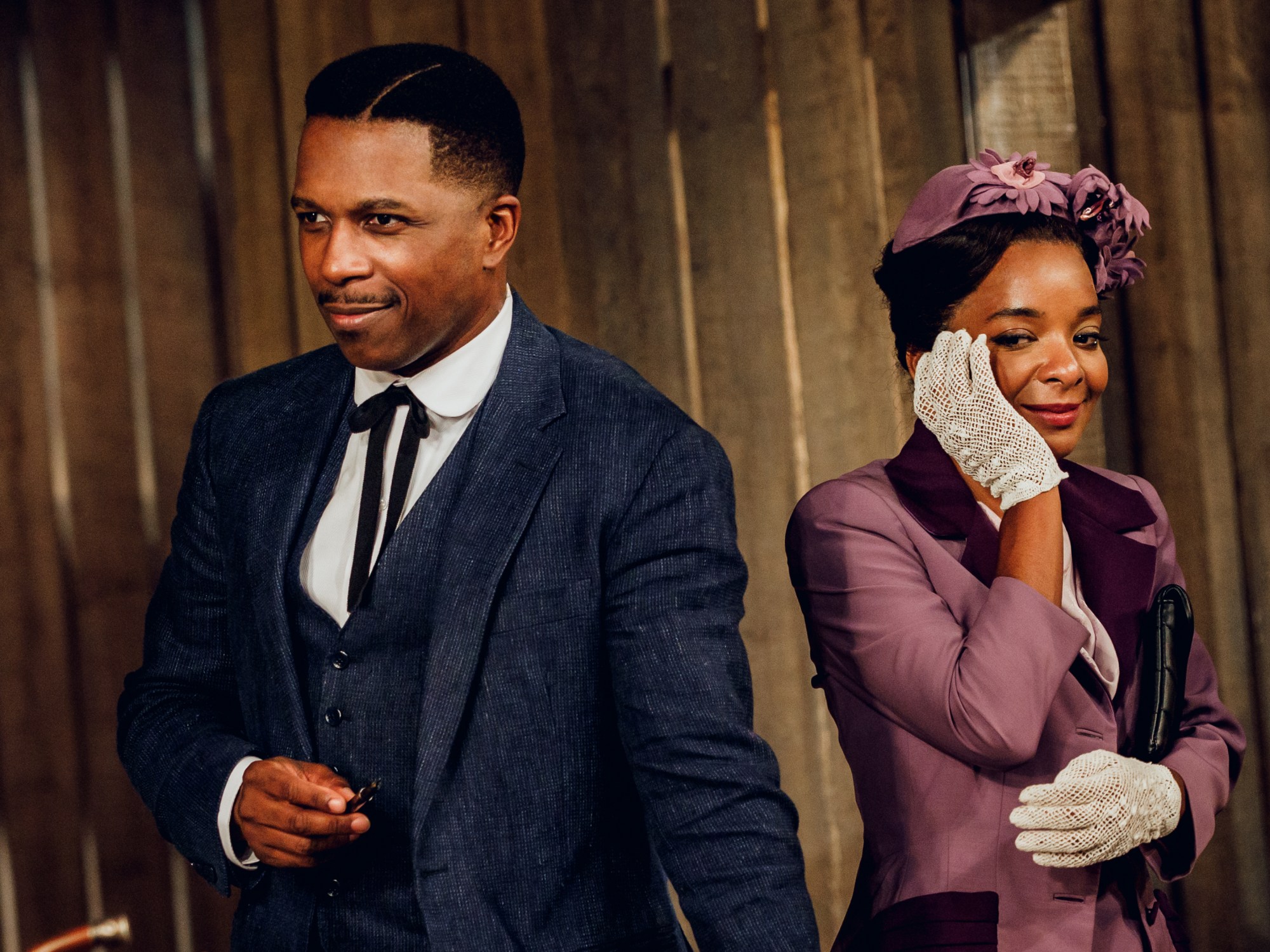
It’s 1961, and Purlie Victorious Judson (Leslie Odom, Jr.) returns to his small hometown in Georgia to save their church, Big Bethel. His plan? He will swindle Ol’ Cap’n Cotchipee (Jay O. Sanders) out of $500 owed his cousin, now dead, by convincing Cotchipee that Lutiebelle Gussie Mae Jenkins (Kara Young) is that cousin’s daughter, though the daughter, too, is dead. “White folks can’t tell one of us from another by the head!” he assures his skeptical sister-in-law, Missy (Heather Alicia Simms).
Cotchipee is keeping the town enslaved to him through debt, but he has a weakness for being praised for his generosity to “my Negras.” The “Reverend” Purlie, a Harold Hill type, may be able to woo him through flattery. Lutibelle is immediately in love: “There’s something I want to ask you” Purlie says to her. “Would you be my disciple?” His brother, Gitlow (Billy Eugene Jones), has curried some favor by playing the Tom to Cotchipee, and he is eager to participate and split the earnings. Some further help is provided by Cotchipee’s integrationist son, Charlie (Noah Robbins).
The current revival of Ossie Davis’ Purlie Victorious (A Non-Confederate Romp through the Cotton Patch) is a terrific combination of farce and satire, complete with rat-a-tat dialogue and broad physical comedy that clocks jokes faster than any stage comedy of recent memory. The length of the title alone should indicate how much is packed into one hundred five minutes. I was reminded of The Importance of Being Earnest and its parade of epigrams. Here, we have “College ain’t so much where you been as how you talk when you get back” and “Being colored can be a lotta fun when ain’t nobody looking.”
The entire cast is phenomenal, but Young stands out as Lutiebell since she is tasked with playing both a yokel as well as that yokel’s impression of a bougie woman. Her eyes alone can telegraph confusion, lust, panic, and euphoria, and her impression of an educated woman, and in particular the halting walk she adopts, brought the house down at the performance I attended.
Before Purlie Victorious begins, as the audience is seating itself, there is a clothing rack center stage, and the lights project a shadow behind it that evokes hanging bodies. At the end of the play, following the salvation of Big Bethel, that space is occupied by a cross, and both director Kenny Leon and writer Davis project a vision of optimism that I don’t quite share. Charlie, in particular, hits a false note. How many sons of the Confederacy, after all, spurned their fathers and joined a Black church? To be clear, Purlie Victorious is a wonderful choice for a revival, but this is in part because it shows us what Davis in 1961 thought was possible and little we have moved toward it in the intervening sixty-two years.
Purlie Victorious (A Non-Confederate Romp through the Cotton Patch) runs through February 4th at the Music Box Theatre. 239 West 45th Street New York, NY. 1 hour 45 minutes. No intermission. Photograph by Marc J. Franklin.
 scribicide