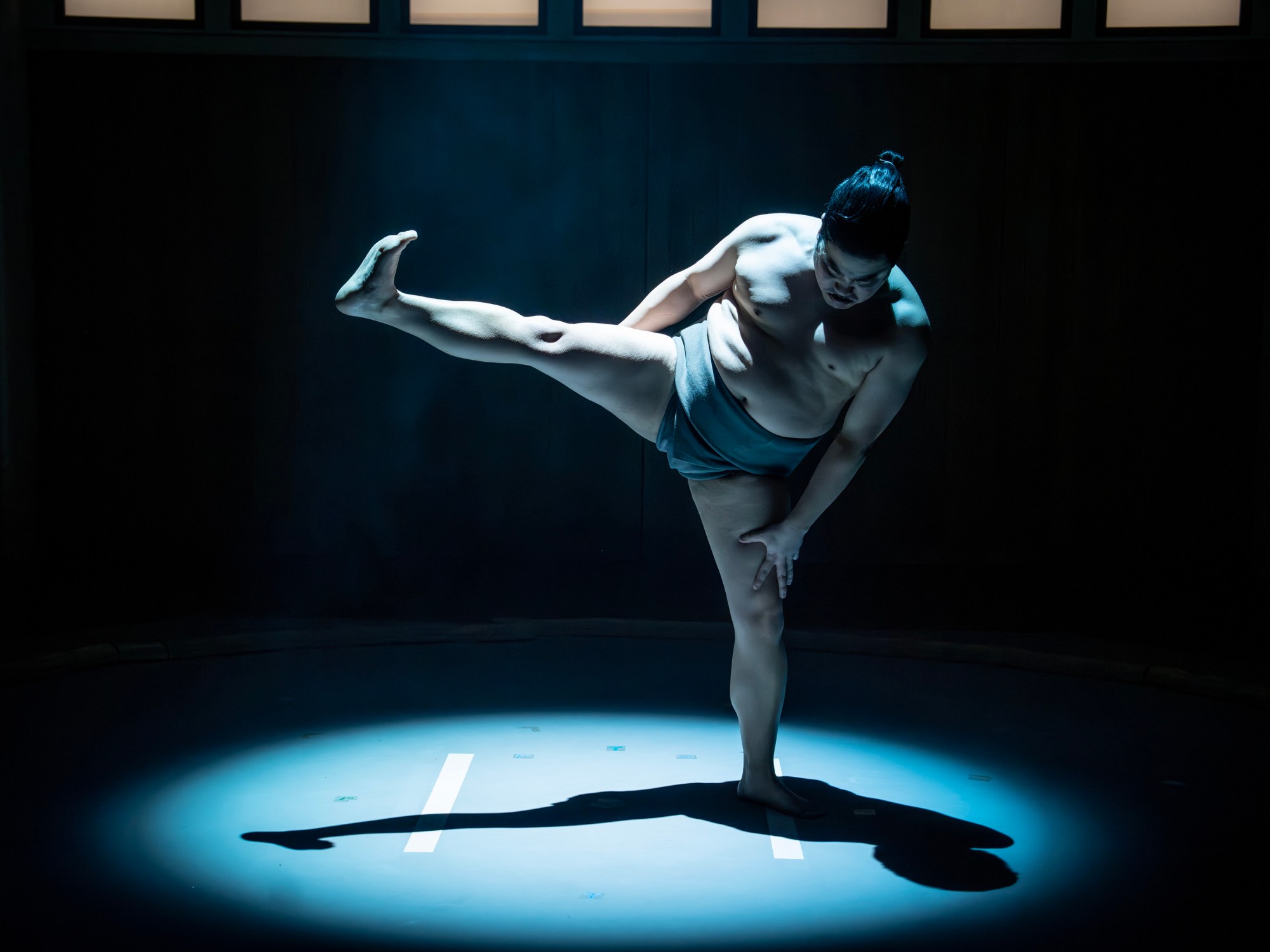
Akio (Scott Keiji Takeda) moves into a stable in Tokyo where he lives and trains as a sumo wrestler. His time is highly regimented, and in the beginning, he spends most of it scrubbing floors, sweeping, and cooking stew. The men are monkish in their devotion to the craft, foregoing relationships with women and wearing, for the most part, traditional clothing (in contrast, their sponsors wear suits and baseball caps). The one indulgence is food, which must be consumed in large quantities, and Akio makes sure to wake up in the middle of the night to eat rice so that he can get big.
On a narrative level, Lisa Sanaye Dring’s Sumo is fairly conventional: in his pursuit of excellence, Akio sacrifices his relationships with the other wrestlers in the stable, though he does avoid developing the heartlessness of their highest-ranked wrestler, Mitsuo (David Shih). However, as an introduction to sumo, the play works well. Dring’s script communicates the essential elements of the sport and the stakes for the athletes without overloading the audience with details. The highlights are the matches themselves, which can last under a minute and consist of giant bodies slapping against one another like a mountain trying to move another mountain. The scenic design by Wilson Chin—primarily the circle dohyō where the wrestlers bout—is simple but effective, and the lighting design by Paul Whitaker helps differentiate between scenes on the small Anspacher stage. I cannot claim I will remember the characters or the drama, but I will not forget the sumo.
Sumo ran through March 30th at the Anspacher Theater. 425 Lafayette Street New York, NY. 2 hours 10 minutes. One intermission. Photograph by Joan Marcus.

