What’s going on with the Beckett estate? The playwright was famous for his demand that directors make no alterations to his texts. When a Dutch theater company staged an all-female Waiting for Godot in 1988, Beckett sued and lost. In response, he banned all productions of his plays in the Netherlands. Since Beckett’s death, his nephew, Edward, has been responsible for the estate, and Edward has maintained the hard line on deviations. In 2019, for example, a student production at Oberlin College was canceled after the estate objected to its all-female cast. The last Broadway revival, starring Patrick Stewart and Ian McKellen, did not break any of the rules.
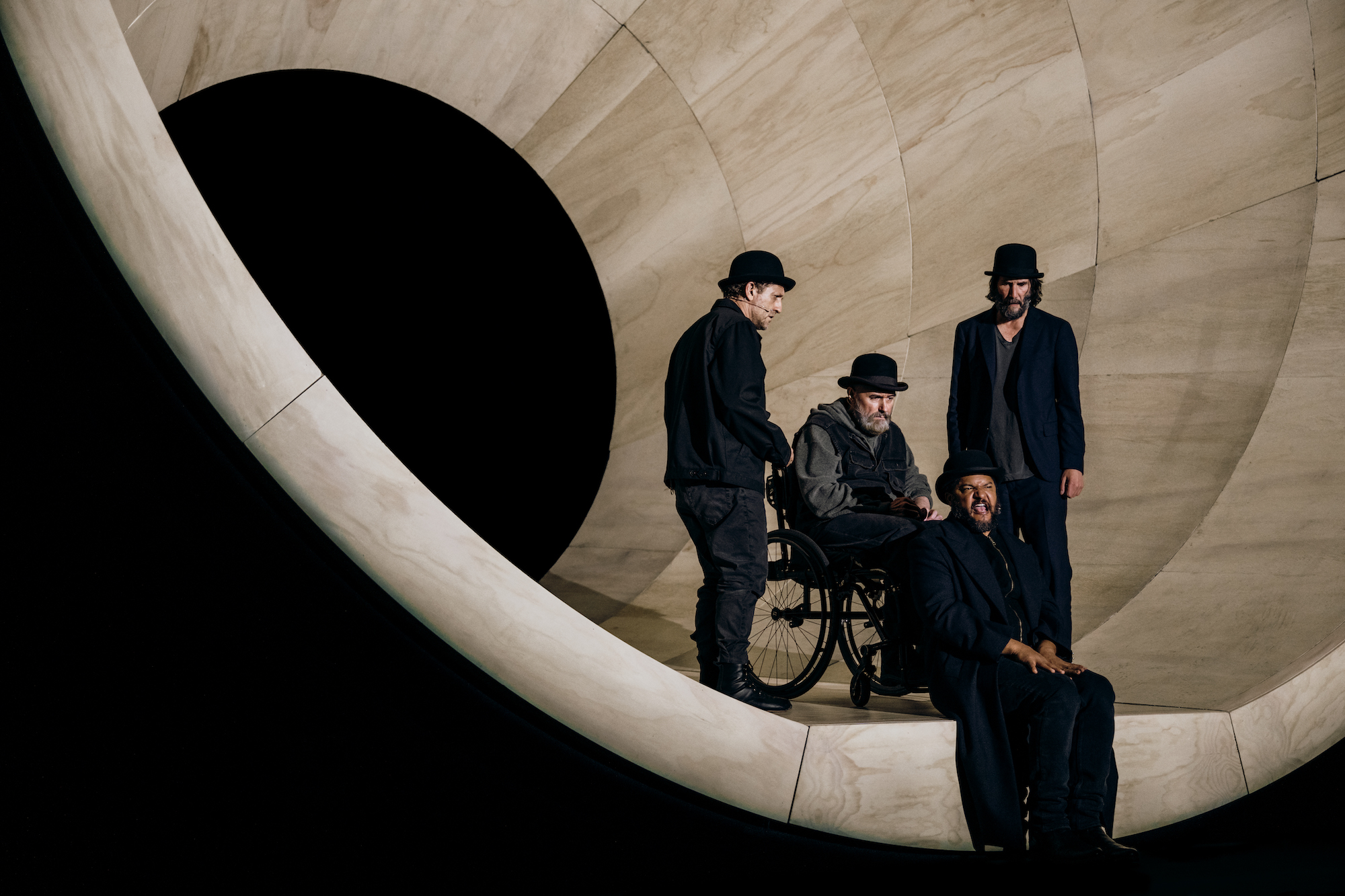
Thus, the biggest surprise of the new Broadway revival, directed by Jamie Lloyd, is that it is staged as if none of the above were true. Deviations abound. The traditional set (“A country road. A tree”) has been replaced with what looks like a bisected sewer tunnel. For much of the play, Didi and Gogo (Alex Winter and Keanu Reeves) sit with their legs hanging over its edge. Lucky (Michael Patrick Thornton), who is written as a beast of burden, carrying luggage and led on a rope leash, in a wheelchair pushed by his master, Pozzo (Brandon J. Dirden), and wearing a mask that makes him look like Bane from Batman. Almost all the props are mimed. And at one point in the second act, Winter and Reeves play air guitar, a reference to their characters from the Bill and Ted movies. When Beckett was asked why women couldn’t play these parts, he said, “Women don’t have prostates,” a reference to Didi’s health problems. One wonders what he would have said about air guitar.
Of course, it doesn’t really matter whether Beckett would object, so long as these choices, bold considering the production history of the play, work. For the most part, they do not. Lucky’s mask and wheelchair diminish the power dynamics of his relationship to Pozzo, and the result is less interesting. Winter and Reeves both seem a little uncomfortable on stage, more so Reeves, who relies too much on a sort of bouncy, puppy-dog harumph gesture. The air guitar is an unfortunate intrusion. The biggest problem, however, is the miming. Waiting for Godot has its roots in vaudeville and silent film comedy—the characters wear Chaplin’s trademark bowler hat—and these work better with props. (Imagine Chaplin miming the forks and bread rolls in The Gold Rush.) I did appreciate the set design, by Soutra Gilmour, which urbanizes the play’s setting while retaining its empty, alienated spirit. The choice to put the characters in silhouette during two key moments was also effective.
If Lloyd’s Waiting for Godot is a sign of things to come, this is an exciting development, one that heralds radical and challenging new interpretations of Beckett’s work. This production, unfortunately, is not one of them.
Waiting for Godot runs through January 4th at the Hudson Theatre. 141 W. 44th Street New York, NY. 2 hours 15 minutes. One intermission. Photograph by Andy Henderson.
 scribicide