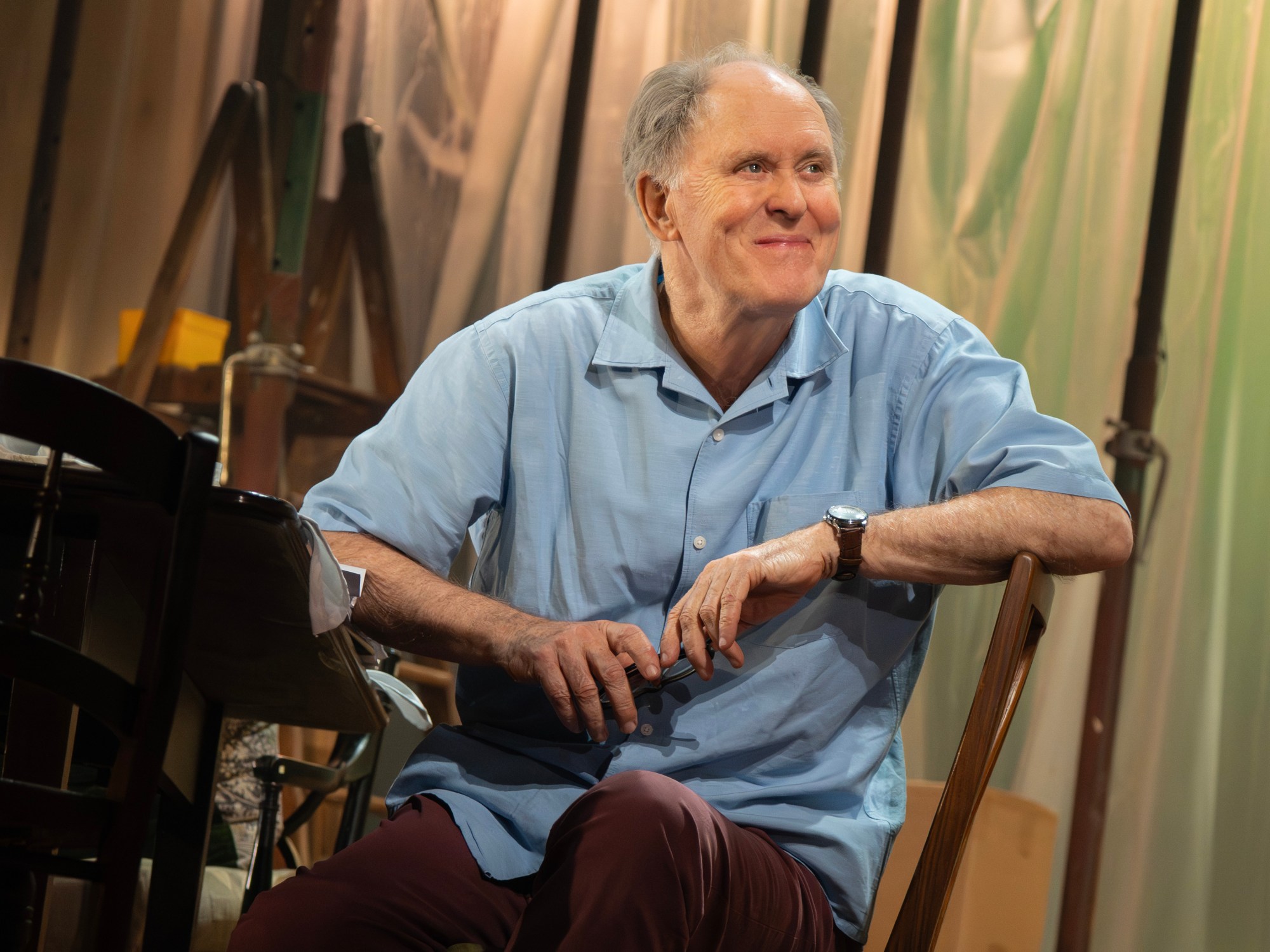
It is the summer of 1983. Roald Dahl (John Lithgow) has finished The Witches, and his team assembles at his home in Great Missenden to work out some kinks in the campaign. Dahl has just written a review of God Cried, a journalistic account of the 1982 Israeli invasion of Lebanon and the Sabra and Shatila massacre. Two passages from the review form the crux of the problem. Here is the first:
Now is the time for the Jews of the world to become anti-Israeli. But do they have the conscience? And do they I wonder, have the guts? Or must Israel, like Germany, be brought to its knees before she learns how to behave in the world?
Here is the second:
Never before in the history of man has a race of people switched so rapidly from being much pitied victims to barbarous murderers. Never before has a race of people generated so much sympathy around the world and then, in the space of a lifetime, succeeded in turning that sympathy into hatred and revulsion.
The problem at the center of Mark Rosenblatt’s Giant, to my eyes, is twofold. First, Dahl is an obvious antisemite, relishing the power his words have to goad. Those familiar with this controversy will already know the famous line, “Even a stinker like Hitler didn’t just pick on them for no reason.” Were this the entire problem, Giant would function as a relatively simple revisionist work, reexamining a luminary in light of his monstrous flaws.
But there is the second problem. Buried in Dahl’s antisemitic provocations is a legitimate critique of Israel. His fiancée (Rachael Stirling) tells his sales director (Aya Cash), “Roald has spent years, long before I knew him, supporting destitute people, children especially, around the world. Lebanon broke his heart.” Surely, much of the audience will think of Gaza, where over twenty thousand children have been killed since 2023. The belief that Jews should be loudest in their protest of Zionism is shared by many of us.
Unfortunately, Rosenblatt’s script does not illustrate these distinctions especially well. Despite the explosive political material, Giant is a rather cautious play, one that doesn’t appear to take much of a stand beyond antisemitism is bad and children should not be murdered. By the end, Dahl has abandoned ambiguity and embraces his role as the frothing antisemite (for example, he dictates a letter to a concerned, Jewish bookseller in faux Yiddishkeit). An easy answer to a difficult question.
Still: while both of the above-quoted passages were recited onstage, an older Jewish woman in my row began speaking. “I agree, I agree with everything he said.” At intermission, a second older Jewish woman became quite angry and started screaming at her (“He said a race, he said a race of people”), and an older Jewish man in the row in front of us shouted at the first woman, “This is a Broadway play, not a revival meeting. Put on a burka so I don’t have to see your ugly fucking face.” This further upset the second woman, who no doubt felt her side of the argument was not coming off too well by association. An usher was called in to adjudicate.
Political theater is meant to rattle; if the audience leaves satisfied, it has failed. So if Giant can rattle both Zionist boomers and anti-Zionist boomers enough to provoke this kind of reaction—which has an effect on all of us who are forced, perhaps awkwardly, to listen—it has done at least one part of its job.
Giant runs through June 28th at the Music Box Theatre. 239 West 45th Street New York, NY. 2 hours 20 minutes. One intermission. Photograph by Joan Marcus.
 scribicide