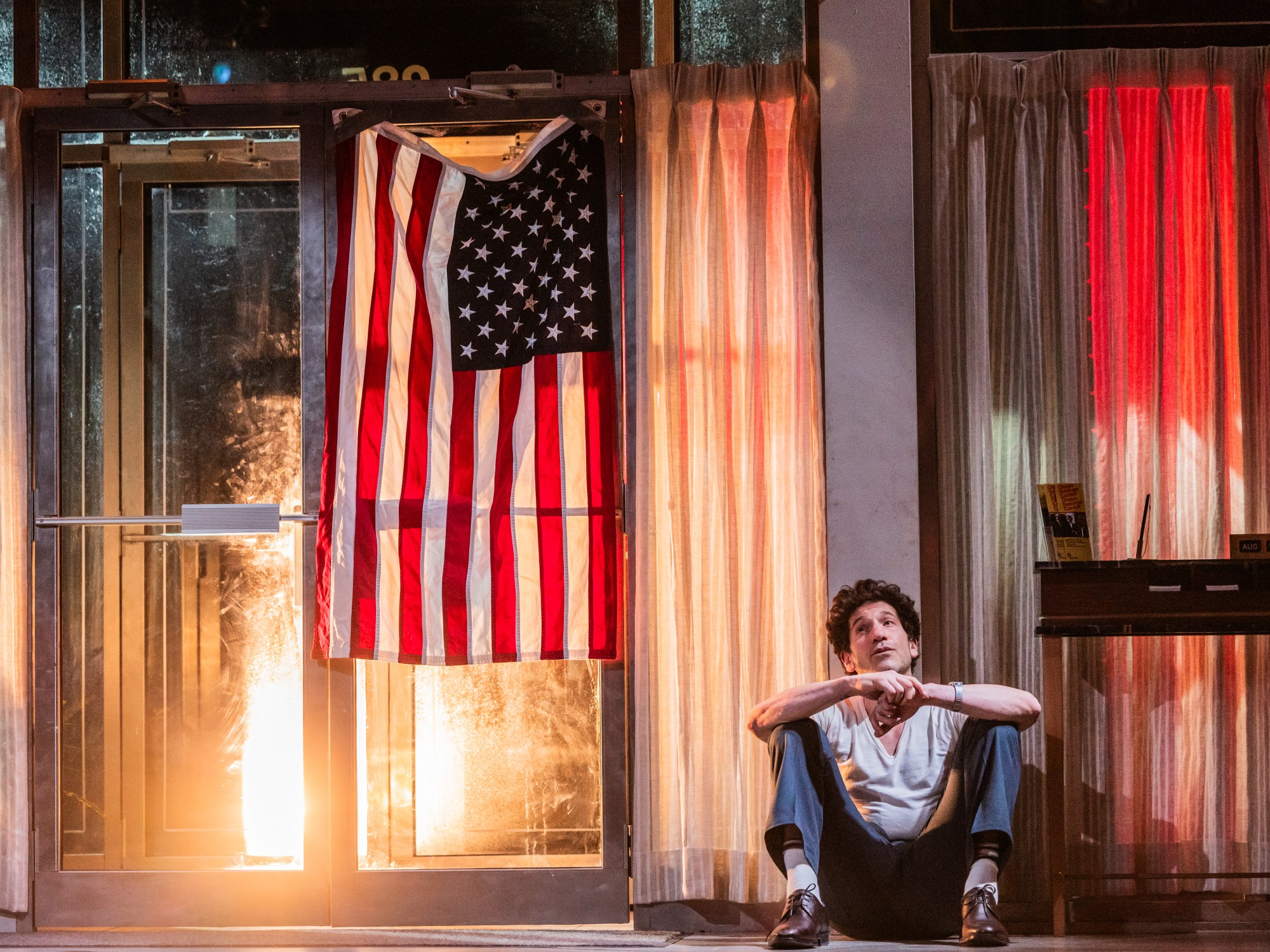
Sidney Lumet’s 1975 Dog Day Afternoon is an obvious choice for stage adaptation. The movie is about a bank heist gone wrong, set almost entirely in the one location, and features a series of small, incredible moments that are perfect for the theater: the way Al Pacino almost drops the gun when he first pulls it out, or how he remembers, at the last minute, that he hasn’t asked if they’re serving food on the plane he’s demanded, or even the single line, spoken by a hostage on the phone, that encapsulates an entire marriage: “Honey, send out for Kentucky Fried Chicken.” Once dinner is settled, he asks whether the bank robbers have guns.
It’s a shame, then, that Stephen Adly Guirgis’ script fails to seize on the source material’s strengths. Consider how each opens. The film includes a montage of location shots, a panorama that makes the subsequent action feel claustrophobic in contrast. The play opens with a series of radio announcers referring to the highlights of the early nineteen seventies: Watergate, inflation, the Knapp Commission. One uses the tools of its medium to shape how the audience feels. The other uses its tools to dump information, a lazy iteration of the scrolling text that opens Star Wars.
This is not a minor detail. The scenic design by David Korins is extraordinary: the stage not only rotates but moves up and downstage, enabling smooth transitions between scenes inside and in front of the bank. Nevertheless, the actors never seem to be inhabiting a real space. Here is one example: as the title says, these are the dog days of summer, and yet there is no more than a perfunctory nod to the heat (buttons are unbuttoned, ties loosened, shirtsleeves rolled up, etc.). We are told it is 98 degrees, but we never feel it. Here is another: every time Sal (Ebon Moss-Bachrach) swings the shotgun, the hostages barely react, and certainly do not react in unison. Why aren’t they ducking?
Moss-Bachrach is the strongest performer in the ensemble, quiet but still telegraphing Sal’s loneliness and anger. Jon Bernthal, as Sonny, doesn’t seem to have found the character yet—he occasionally sounds like he’s doing an impression of Pacino. Perhaps the show hasn’t found itself, either. There is a tonal inconsistency here: the production is not grounded enough for drama, but neither is it broad enough for straight comedy or satire. Revision might reveal what Guirgis sees in this story (and I hope that revision includes a toning down of the “Attica!” scene, which is played here like a one-hit wonder’s one hit).
Dog Day Afternoon runs through July 12th at the August Wilson Theatre. 245 West 52nd Street New York, NY. 2 hours 15 minutes. One intermission. Photograph by Matthew Murphy and Evan Zimmerman.
 scribicide