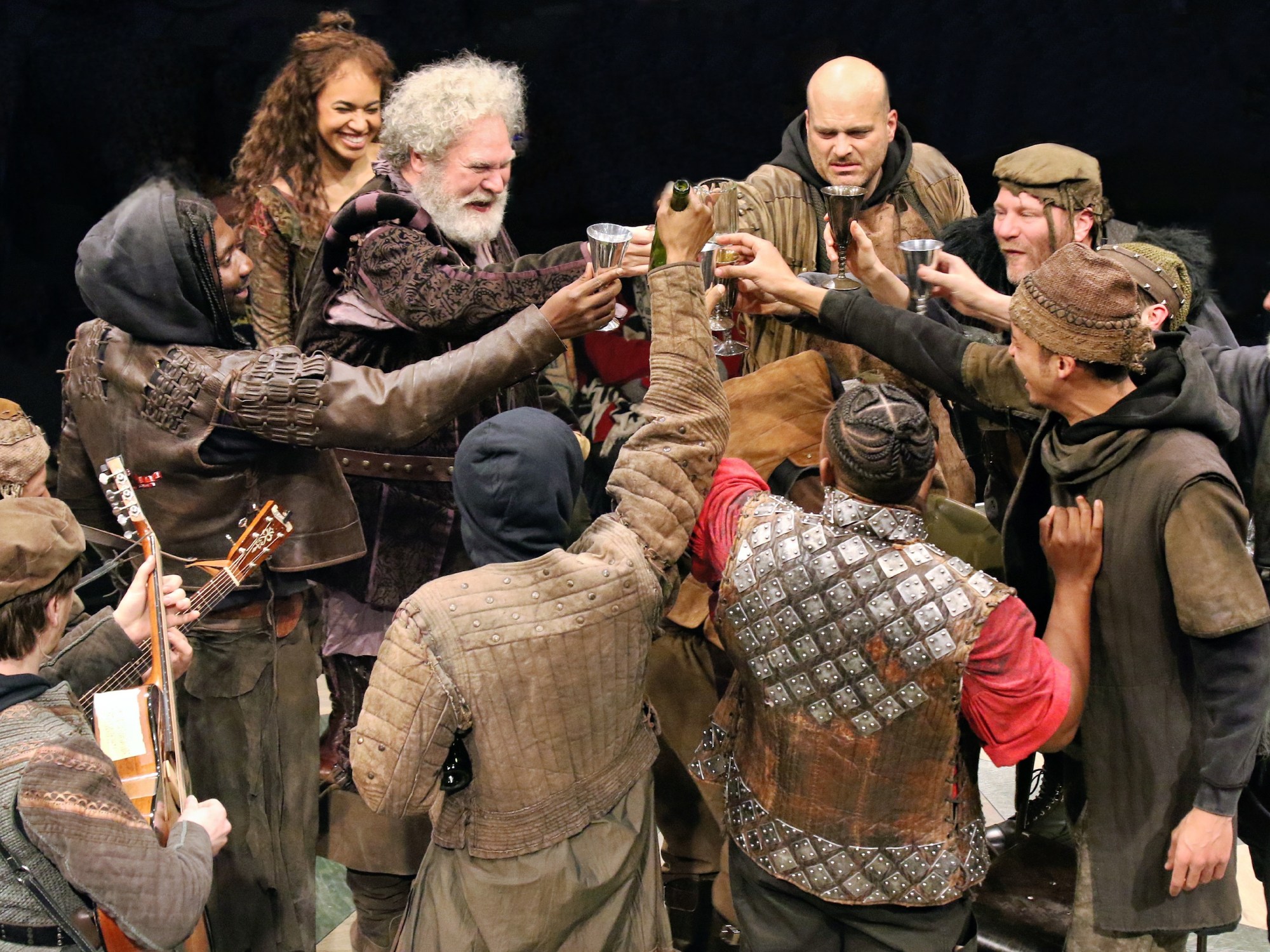
Because you need to watch Henry IV, Part 1 to understand Henry IV, Part 2, you rarely get to see it. The only standalone production in recent New York memory was from the Royal Shakespeare Company in 2016, and that was presented alongside Part 1 as well as Richard II and Henry V. Most companies who even bother to touch the sequel take out their chainsaw, pare down the text, and stage a truncated version, as Theatre for a New Audience has done with their four-hour Henry IV. This enables the audience to see the full arc of its central relationship, the friendship (or not) between Prince Hal (Elijah Jones) and Falstaff (Jay O. Sanders). Since the latter character has a greater hold on the imagination of audiences, these truncated versions are often referred to as The Falstaffiad. Orson Welles did it with Chimes at Midnight, and director Eric Tucker and adaptor Dakin Matthews are doing it here.
Kudos to Theatre for a New Audience for mounting what must be a hard sell in a dire theatrical landscape—at the performance I attended, too many seats were empty. Nevertheless, I am sorry to report that the production fails to breathe vitality into a play that is full of it. The stage is placed in the center of the theater, and the audience is arranged around it. This creates poor sightlines for almost everyone. (I was reminded of Mel Brooks: “You’ve all heard of theater in the round? You’re looking at the man who invented theater in the square! Nobody had a good seat!”) A spare, minimalist set does not distinguish between scenes, making the production visually monotonous. The empty space and the high ceiling swallow up the actors’ voices, and it is difficult to hear them when they are not facing you. I did enjoy some of the performances, in particular John Keating’s Robert Shallow, who was big and loud and matched the energy of Shakespeare’s writing.
I have been watching Tucker’s direction for over ten years, first in a scrappy production of Saint Joan at the ironically named Access Theater (you have to walk up stairs). His minimalist approach, with few props and actors fielding a number of roles, worked better in the context of that space, which he opened up by staging one scene in the lobby and another in the orchestra while the audience sat onstage. It doesn’t work in a bigger theater, and the result feels less like invention under restraint and more like a lack of imagination.
Again, I am happy to see a theater producing the Falstaffiad in 2025. I just wish it were better.
Henry IV runs through March 2nd at the Polonsky Shakespeare Center. 262 Ashland Place Brooklyn, NY. 3 hours 45 minutes. Two intermissions. Photograph by Gerry Goodstein.
 scribicide