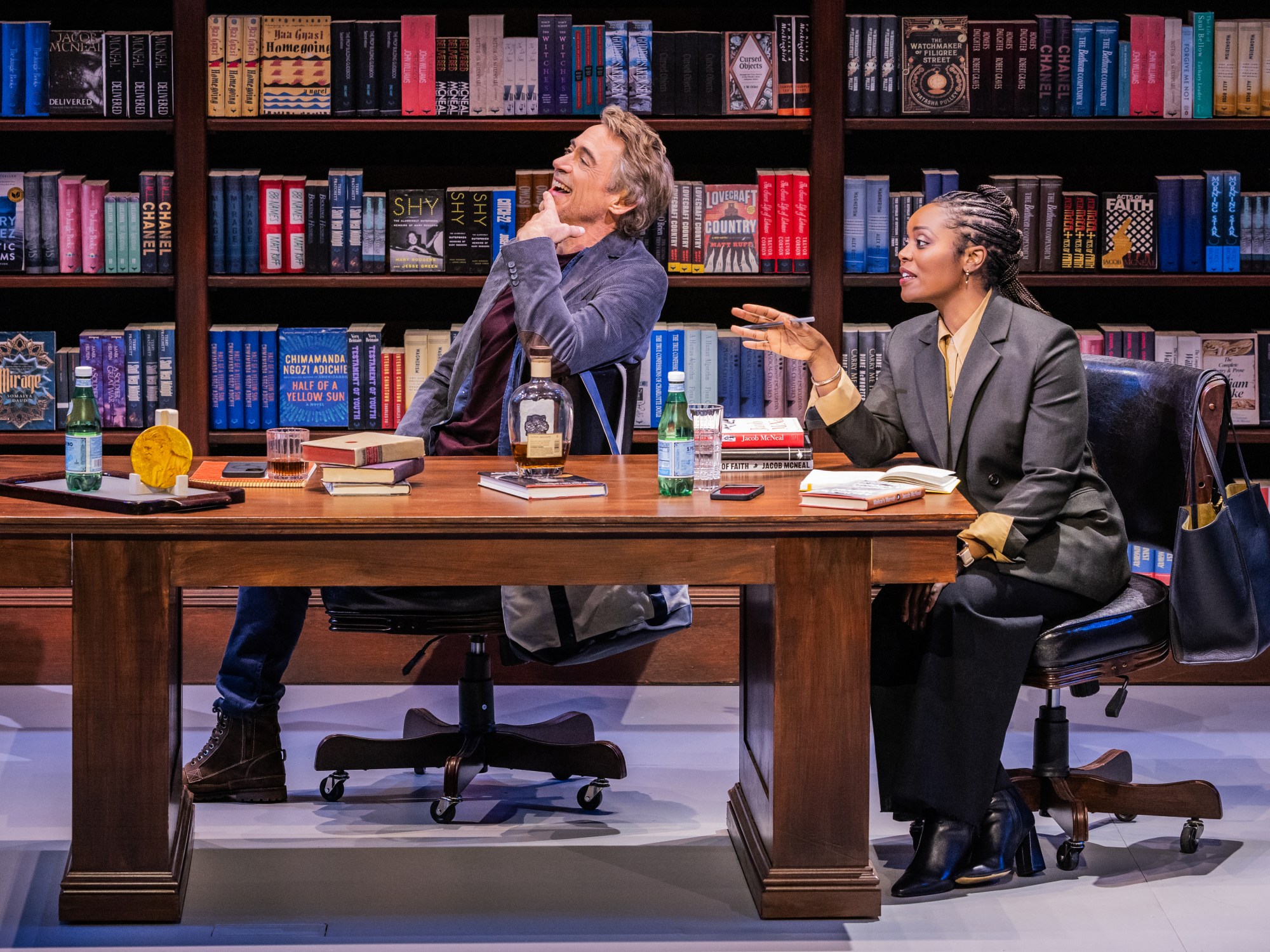
An American novelist, Joseph McNeal (Robert Downey Jr.), wins the Nobel Prize and, as a lark, he enters his speech into a generative AI chatbot. McNeal is relieved that he doesn’t prefer the machine’s version. But the bug is in his ear, and he dumps all sorts of documents into the machine: notebooks, diaries, his dead wife’s unpublished manuscript, some Shakespeare and Ibsen.
The result is a new novel written from the perspective of a woman, which surprises both his fans and his foes. McNeal is a charming asshole, an alcoholic womanizer who is a martyr to his art and a manipulative jerk to the people he loves. His wife may have committed suicide because of how he treated her, and his son only speaks to him through monosyllabic texts. McNeal is about to be profiled by The New York Times Magazine, but only because the editor, a spurned mistress, just left.
Ayad Akhtar’s McNeal is divided into two primary concerns. On the one hand, this is a play about artificial intelligence and creativity. What are the ethical and unethical uses of generative AI, and how should those uses be disclosed? More philosophically, is there something human about the creation of art that will forever lie outside the bounds of machine learning? If not, what does it mean when art, which is fundamentally a form of play, is outsourced to an algorithm?
On the other hand, McNeal is a play about the ethics of writing. Everyone seems to be angry with McNeal because he has taken stories he’s heard or experienced and used them in his novels. (Philip Roth, who is surely one source for McNeal, loved to quote the Polish poet Czesław Miłosz: “When a writer is born into a family, the family is finished.”)
The problem with McNeal is that the first concern is much more interesting than the second. It is understandable that people will feel used by McNeal when he takes their lives and adapts them for his fiction. But this is what writers do, and McNeal seems to suggest its title character should feel some kind of guilt over this. For what? For being a writer?
Furthermore, the play is riddled with problems of plausibility. Early on, we are told that years ago, a list of the nominees for the Nobel Prize in Literature was leaked. McNeal’s name was on the list, and since then, he has been riddled with anxiety every October, when the winner is announced. In fact, the list of nominees for the prize must be enormous, since the criteria to nominate are quite broad and include anyone who is elected to a legislature or anyone who teaches at a university. In other words, Matt Gaetz could nominate a candidate for the Nobel Prize in Literature. A leak that includes McNeal’s name would not suggest, as the play indicates, that McNeal was a likely candidate. It just means one person thought he deserved it.
Perhaps this is a quibble. But later, we are asked to believe that the reporter writing the New York Times Magazine cover story (Brittany Bellizeare) has not actually read all nine of McNeal’s novels. She’s still working on it. I know journalism is at a nadir, and funding is tight, but I do think the New York Times Magazine can still afford a writer who is familiar with the subject they have chosen for their cover story.
Finally, while Downey Jr. is certainly equipped to play a charming asshole, and while there is a good deal of fun in watching him do so, it is a lazy caricature that we have seen in representations of writers for decades. David Duchovny played one for seven seasons on Californication.
I loved Akhtar’s last three plays, and I have no doubt he remains an important and exciting playwright. If McNeal is evidence to the contrary, I expect that it is an exception.
McNeal runs through November 24th at the Vivian Beaumont Theater. 150 W. 65th Street New York, NY. 1 hour 45 minutes. No intermission. Photograph by Matthew Murphy and Evan Zimmerman.
 scribicide